
Presentations
- Southern California Conference for Undergraduate Research (SCCUR) 2026: Research abstract accepted to the conference. Jun will present the poster.
- The group presented the poster at BU RISE Poster Symposium.
Poster
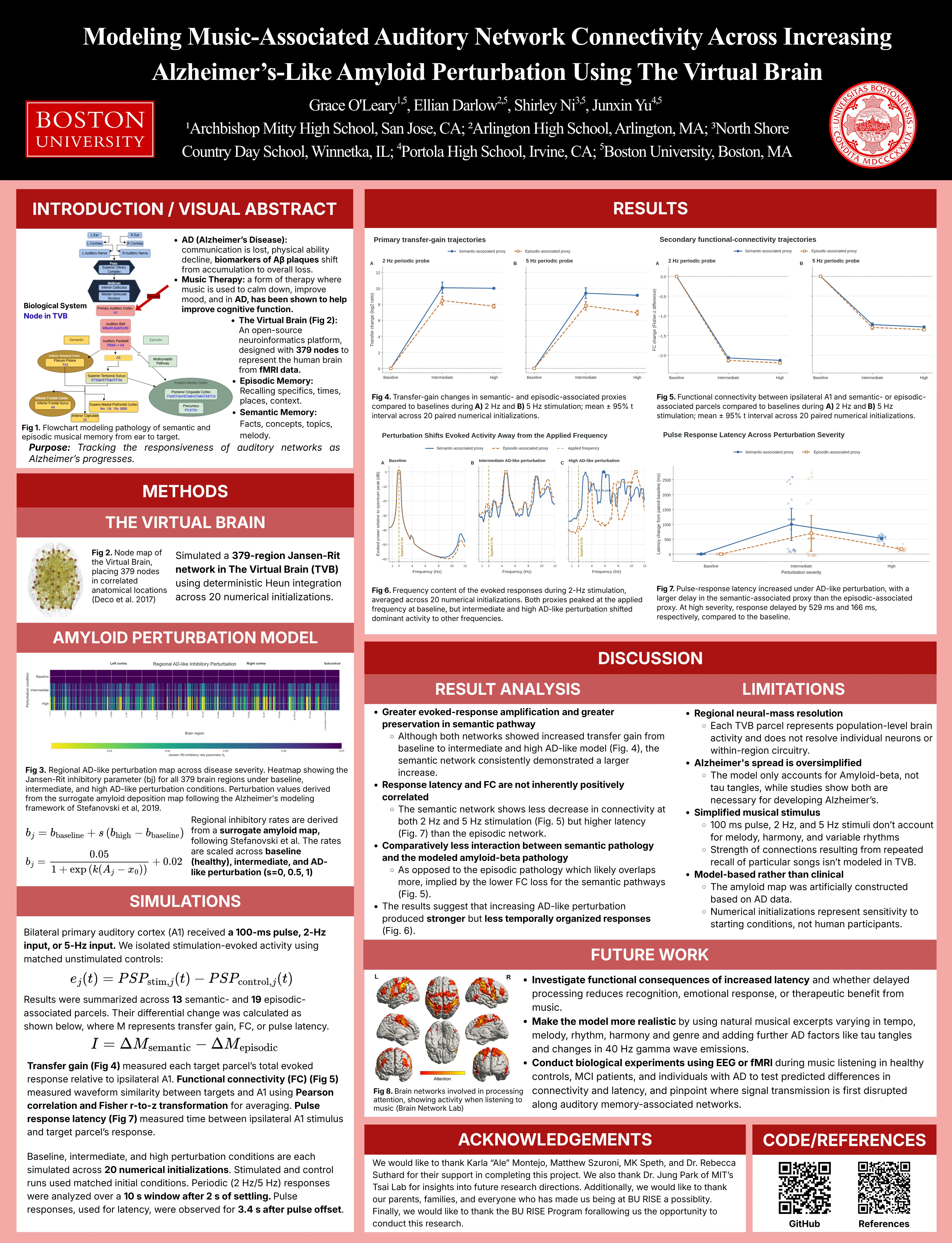
Abstract
Alzheimer’s disease (AD), characterized by gradual loss of memory and cognitive function, affects over 30 million people worldwide. Many patients are unable to recognize familiar concepts, people, and places, but recognize familiar music. Specifically, experiments have shown that despite deficits in episodic musical memory (e.g. the context in which music was heard), semantic musical memory (e.g. the melody) remains preserved; however, the neurological mechanisms underlying this phenomenon remain poorly understood. We hypothesize that changes in functional connectivity (FC) of music processing pathways induce differences in semantic and episodic musical memory capacity, with the episodic musical network regressing across healthy control (HC), mild cognitive impairment (MCI)-like, and AD-like conditions, and the semantic musical network remaining comparatively stable across these same conditions. To assess the changes in these networks as AD-like perturbation increases, we used the Virtual Brain (TVB) to simulate a 379-region brain network. Following a previous study, we transformed a surrogate amyloid map to produce AD-like perturbation conditions in TVB. We stimulated primary auditory cortices bilaterally with a 100-ms constant-amplitude pulse, a 2 Hz signal, and a 5 Hz signal, maintaining total input power. We subtracted the unstimulated output, then normalized FC, transfer gain, and response latency per network. We reported the differences in FC, gain, and latency between the networks using interaction analysis. Across 20 paired initializations, we tested the semantic-versus-episodic interaction contrast against the null hypothesis using a two-sided one-sample t-test. With increasing perturbation, the semantic-associated network showed less FC loss and greater transfer-gain increases than the episodic-associated network, although its pulse-response latency increased more. This work has the potential to identify circuits that remain viable targets for music-based interventions in AD patients, providing potential avenues for novel treatment strategies.
Acknowledgements
We would like to thank Karla “Ale” Montejo, Matthew Szuroni, MK Speth, and Dr. Rebecca Suthard for their support in completing this project. We also thank Dr. Jung Park of MIT’s Tsai Lab for insights into future research directions. Additionally, we would like to thank our parents, families, and everyone who has made us being at BU RISE a possibility. Finally, we would like to thank the BU RISE Program for allowing us the opportunity to conduct this research.